 Sourced,
 Official Park Rules
 Written Offer
 02Komodo vs Rinca
 05Safety on the Walk
 06Rangers
 09Best Time to Go
 12Getting There
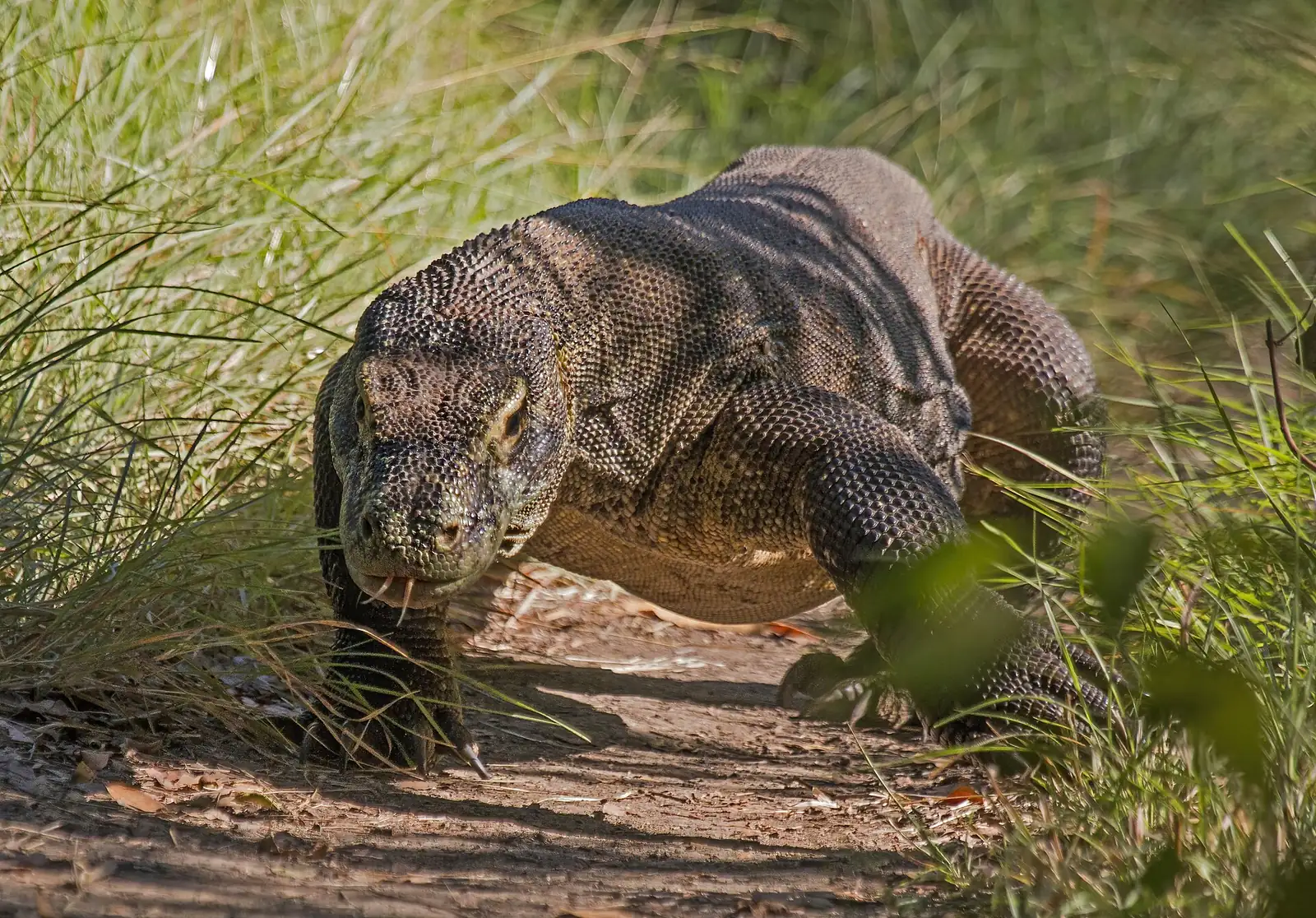
 An adult Komodo dragon walks a grassy path on Rinca in Komodo National Park.
 A Komodo dragon crosses a woodland clearing on Komodo Island.
 A Komodo dragon walks through open forest on Komodo Island.
 A Komodo dragon rests in the open on a trail on Komodo Island.
 A Komodo dragon forages among dry leaf litter on Komodo Island in August.
 Two Komodo dragons pause on a marked track on Komodo Island.
 Interest stated openly
 Send your question
 Decide in writing
On this page
- Where can you see Komodo dragons in the wild?
- How does a dragon walk actually work?
- Is Komodo or Rinca the better starting point?
- How dangerous is it to see them?
- When should you go?
- What has changed for visitors since 2026?
- What else do first-time visitors ask?
- Which published prices did we check?
- Which sources support this page?
- How do I reach the desk?
By See Komodo Dragons Editorial Desk
To see Komodo dragons in the wild, you travel to Komodo National Park in Indonesia, between Sumbawa and Flores, and walk a guided route on Komodo or Rinca, usually reached by boat from Labuan Bajo. Sightings are common enough to draw visitors but cannot be guaranteed, and a daily quota now shapes how entry works.
Where can you see Komodo dragons in the wild?
UNESCO says these lizards exist nowhere else in the world, and their whole range fits inside a small corner of Indonesia. The park authority lists dragons on five large islands inside the park: Komodo, Rinca, Padar, Gili Motang and Nusa Kode. UNESCO also names coastal parts of western and northern Flores, which lie beyond that list. Sources do not all agree about Padar, and our guide to where to see Komodo dragons sets the lists side by side.
For a first trip the choice narrows to two islands. In an October 2020 report the BBC said most of the lizards live on Komodo, with the second-largest population on Rinca. Other sources disagree, as our Komodo vs Rinca comparison shows. We can point you to no visitor facility or access rule for Gili Motang or Nusa Kode, so leave both out of your plan unless a park officer tells you otherwise.
| Place | What the sources say | Read next |
|---|---|---|
| Komodo | Most of the lizards, per the BBC in 2020. Wikipedia gives 291 km2 and about 1,800 residents in 2020. | Dragons on Komodo Island |
| Rinca | Second-largest population, per the same BBC report. | Dragons on Rinca Island |
| Padar | On the park authority's list. Smithsonian's National Zoo reports no sightings since the 1970s. | Dragons on Padar |
| Flores coasts | Named by UNESCO. Conservation sources describe reserves there, with no detail on visitor access. | Dragons on Flores |
| Gili Motang and Nusa Kode | On the park authority's list. No visitor information that we know of. | Ask the park office |
Most of the park is sea, so a boat sits at the centre of nearly any plan. The park authority counts at least 142 small islands and far more water than land. Sources differ on the park's total area, and our about page shows the figures side by side.
How does a dragon walk actually work?
Seeing Komodo dragons usually follows the sequence below, which reflects reported practice. Times and routes vary, and the people on site decide the details.
- Reach Labuan Bajo. Wikivoyage says several daily flights link Denpasar with Komodo Airport (LBJ) at Labuan Bajo. Check current schedules with the airline.
- Sort out park entry before the boat leaves. The price table on this page shows the official entry fee for foreign visitors, with its source. The section on 2026 changes below covers the quota.
- Cross to a ranger station. Our page on how to get to Komodo Island deals with the crossing.
- Walk with a guide. Wikivoyage says touring without local guides is neither permitted nor advisable. The price table also lists official guiding at Loh Buaya on Rinca and at Gililawa, and that official page does not cover Loh Liang on Komodo.
- Do as you are told. The park's visitor protocol bars visitors from ignoring what park officers or the naturalist guide on duty tell them. It also prohibits touching animals or getting too close to them, on land or in the water, without stating a distance in metres.
Your guide cannot produce a dragon on request. We quote no percentage chance of a sighting, because we know of no park or academic dataset of visitor sighting rates. If someone gives you a figure, ask where it comes from. Our page on Komodo National Park rangers explains who walks with you and what they do.
Is Komodo or Rinca the better starting point?
Neither has proof behind it. Claims that one island gives better sightings than the other rest on operator opinion and an undated encyclopedia line, so treat them as opinion. Logistics give you firmer ground for a decision. Put these questions to whoever is arranging your day:
- How long will we spend on the water to reach each ranger station on our date, given current sea conditions?
- Which route will we walk, and who chooses it on the day?
- What else does the boat day include, and does a second stop cut the time ashore?
- Can everyone in the group manage the walk? Our notes on Komodo dragon walk difficulty help you judge this for older travellers and children.
The answers will differ by operator and by date. Our Komodo vs Rinca comparison lays out the differences that the sources do support, including the operator opinions, labelled as such.
How dangerous is it to see them?
Dragons are large wild carnivores. Smithsonian's National Zoo says wild ones typically weigh about 70 kg, with the largest verified specimen at 3.13 m and 166 kg, and our page on how big Komodo dragons are sets that beside other sources.
They have injured and killed people. Our dated record of attacks shows who was hurt, where and in what circumstances, including villagers, park staff and a tourist bitten in 2017. Nobody can promise you a safe walk, and we do not.
You do control your own conduct. Our Komodo dragon safety page goes through it in order: before landing, on the path, near a dragon, and if one moves toward you.
The risk also runs the other way. The IUCN Red List classes the species as Endangered, in an assessment dated August 2019 and published in 2021. Park monitoring recorded about 3,156 dragons in 2022, and our page on how many Komodo dragons are left explains why that differs from the Red List's count of mature animals.
When should you go?
You can plan around rain, though not around dragons. Wikipedia, citing Climate-Data.org, puts heavy rain at Labuan Bajo in December to March, with moderate to little from April to November. That is modelled data for the town, and the islands may differ. Smithsonian's National Zoo places dragon mating between May and August, inside those drier months, and watching it cannot be planned.
If your dates are fixed, raise entry arrangements early and ask whether a spare day would help a ticket tied to one date. Our page on the best time to see Komodo dragons goes through the year season by season.
What has changed for visitors since 2026?
The forestry ministry set a quota of 1,000 people per day, about 365,000 per year, from 1 April 2026. Jakarta Globe reported that the SiOra mobile application would handle registration and the distribution of visitors. Published details of how the quota runs in practice conflict, so read our page on the Komodo National Park visitor limit before you pay for anything tied to a single day. The park office's acting head said in September 2026 that the year's allowance was booked and that extra daily places were being added to December.
Management sits with the state. Indonesia's central government runs the park through the forestry ministry's conservation directorate, and the Balai Taman Nasional Komodo office sits in Labuan Bajo. Antara dates the park's UNESCO World Heritage inscription to 1991. This site is a separate thing: a travel guide with a request desk, under Juara Holding Group. We run no tours, boats or rooms, and we issue no park tickets.
What else do first-time visitors ask?
Can you see Komodo dragons in the wild?
Yes. Visits usually take the form of a guided walk on Komodo or Rinca inside Komodo National Park. They live free on the islands, so you may walk the route and see few, or none.
What are the chances of seeing a Komodo dragon?
Sightings are common enough to draw people here, and nobody can guarantee one on your date. The walk section above explains why we quote no percentage.
Why are Komodo dragon sightings not guaranteed?
Dragons move where they choose, and the park protocol bans feeding them. A guide can take you along the permitted route, but no guide controls where an animal is that morning.
Is Komodo National Park the only place to see wild Komodo dragons?
The park is where visits are organised, but UNESCO also places dragons on coastal parts of western and northern Flores. Sources on Flores reserves describe conservation work and give no detail on visitor access, permits or guides there.
Which published prices did we check?
Official fees and public third-party listings, each with its source and the month we checked it. These are not our prices or offers. Fees change and sources sometimes disagree, so check the source before you rely on a figure.
| Item | Published price | Source | Checked |
|---|---|---|---|
| Komodo National Park entry, foreign visitor, per person per day (official tariff notice under Government Regulation 36 of 2024; listed under weekdays and Saturday) | IDR 250,000 | tnkomodo.ksdae.kehutanan.go.id | Nov 2026 |
| Guiding by the park-licensed cooperative at Loh Buaya (Rinca) and Gililawa, per group of 5 (park guiding page; the page does not cover Loh Liang) | IDR 200,000 | tnkomodo.ksdae.kehutanan.go.id | Nov 2026 |
Which sources support this page?
- UNESCO World Heritage Centre: Komodo National Park
- Komodo National Park authority: fauna page
- BBC News, October 2020
- Komodo National Park: general information
- Wikivoyage: Komodo National Park
- Komodo National Park: visitor protocol
- Smithsonian's National Zoo: Komodo dragon
- IUCN Red List: Komodo dragon
- Wikipedia: Labuan Bajo
- Indonesian forestry ministry: visitor quota release
- Jakarta Globe: visitor cap and SiOra
- RRI: park office adjusts quota distribution, September 2026
- Komodo National Park: international titles and management
- Antara: government to limit visitors
- Komodo National Park authority: tariff notice
- Komodo National Park authority: guiding
How do I reach the desk?
Send your dates, group size and what you most want to see. The desk has a commercial interest, because a request can turn into a paid booking. It answers questions and cannot promise a boat, a date or a sighting. Only a written offer binds anyone, and it names any fee, the price and the contracting company before you agree.
WhatsApp: +62 811-3823-875. Email: email the desk.
Send the desk your dates and where you are coming from. The desk replies in writing.
Ask the desk on WhatsApp sales@komodoluxury.com